
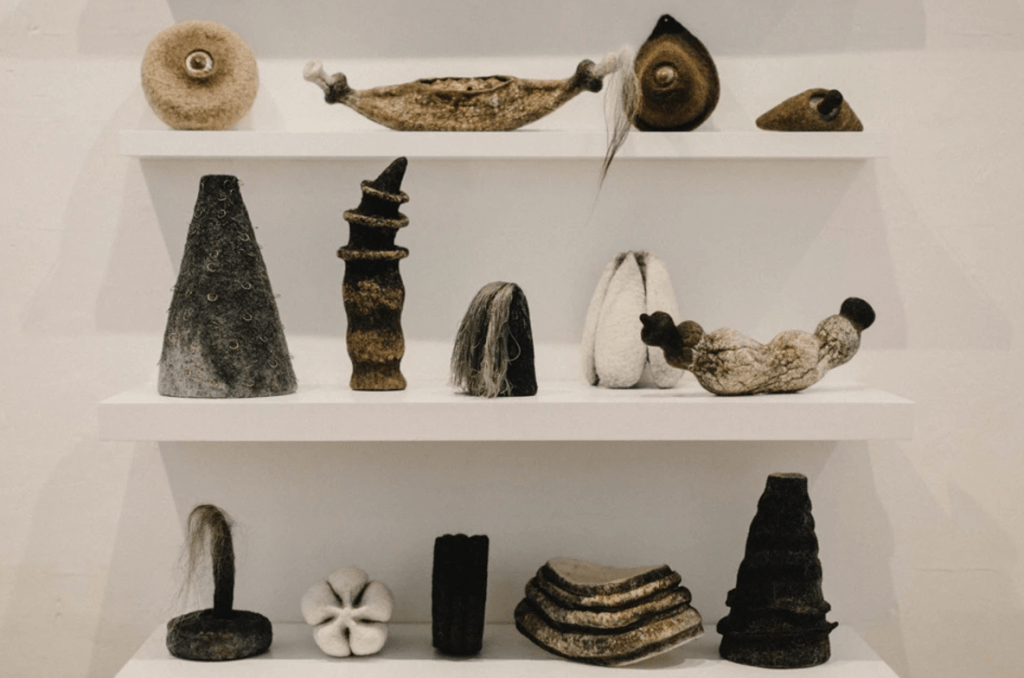
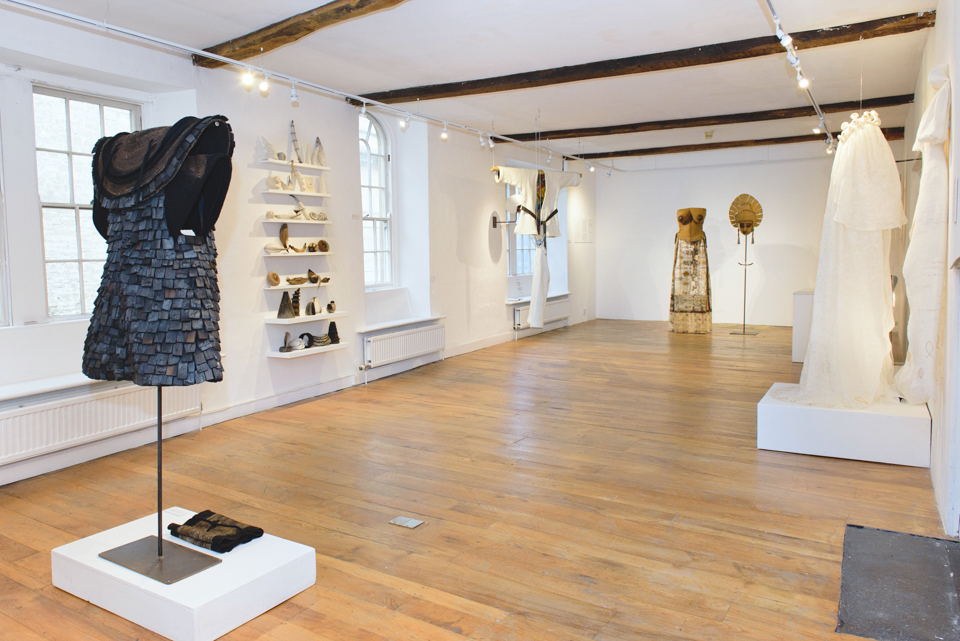
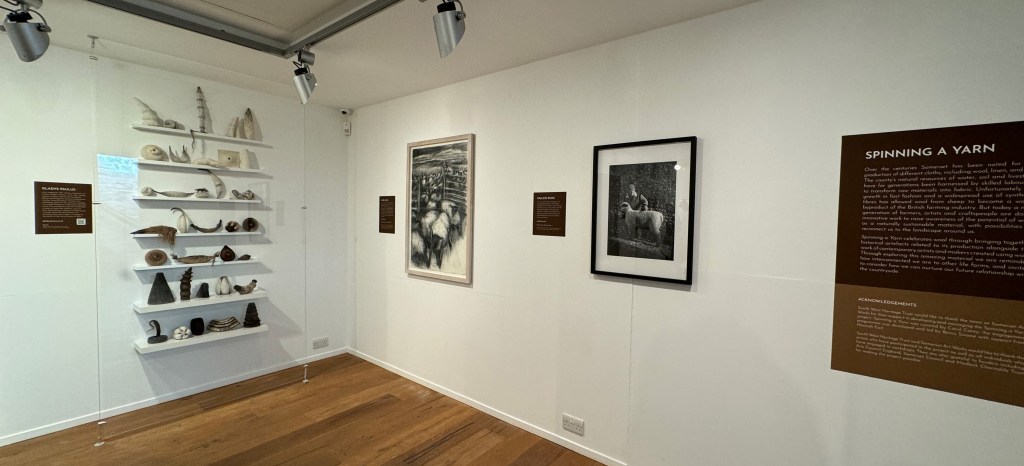
Gladys Paulus‘ beautiful and emotive felt sculptural objects were displayed in the Mapstone Gallery as part of Spinning a Yarn. Her work explores remembrance, ancestry, identity, sacredness and belonging, straddling the worlds of fine art, traditional crafts and ritual. Pushing the boundaries of the medium of felt, Gladys Paulus is a fourth generation artist and maker of Dutch-Indonesian heritage, living and working in Somerset.
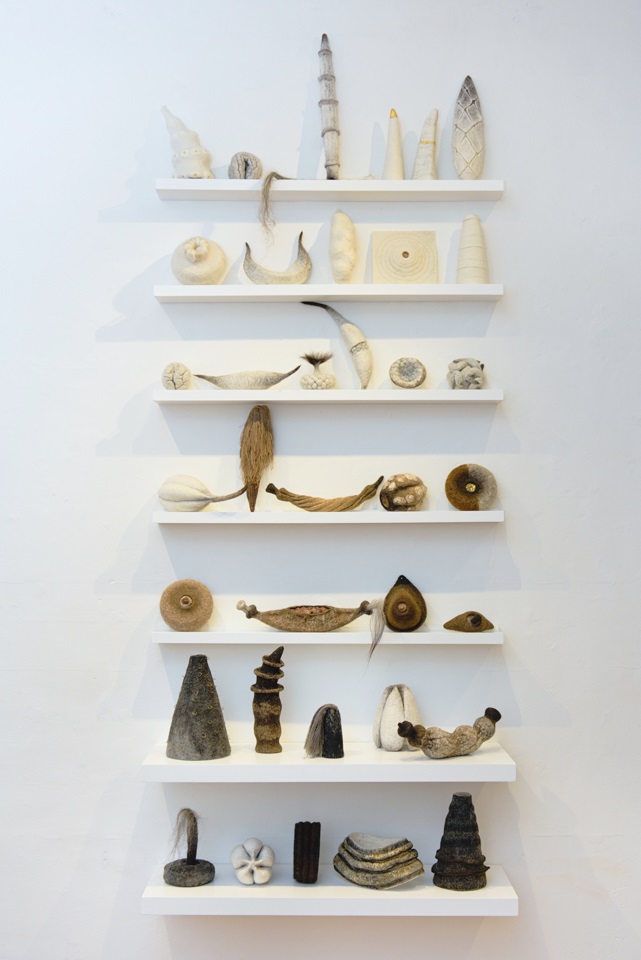
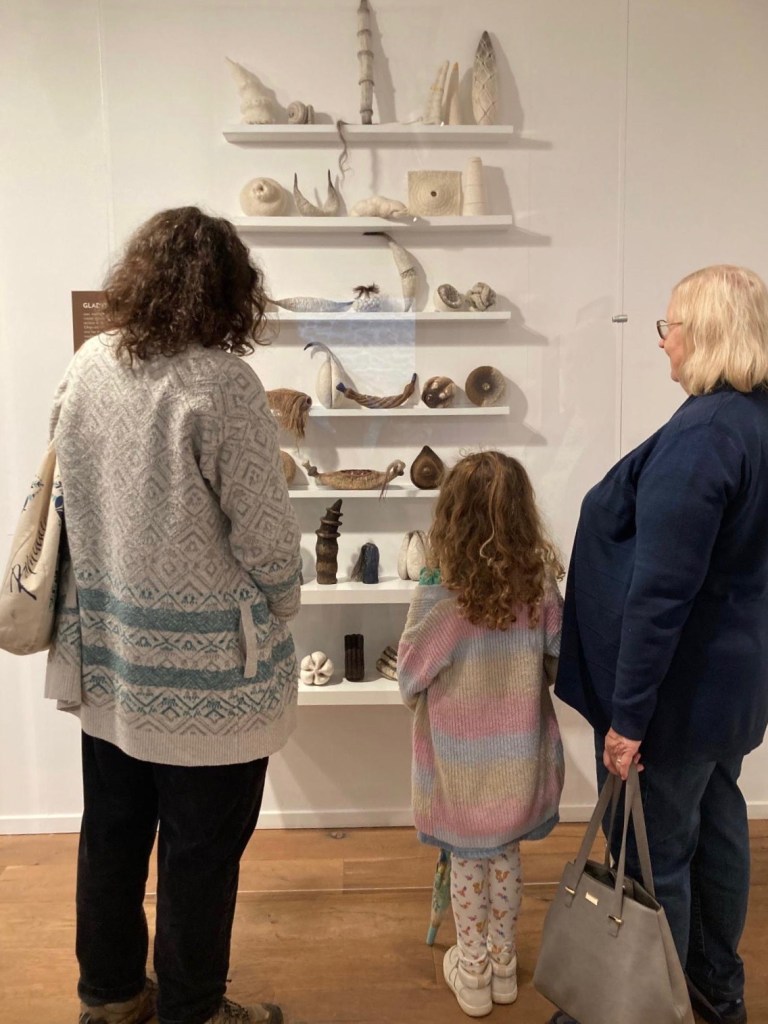
Rituals (2015-17). Wool, hair, silk, cotton scrim, copper, brass, gold leaf. Shown as part of Spinning a Yarn.
Gladys Paulus, December 2024
“Whenever people ask me what I do for a living, I struggle to answer. Not because I don’t know what I do (of course I know!), but because often people look at me with confusion, they mis-hear, or they simply find it difficult to picture.
I’m an artist, first and foremost.
The majority of my work is sculptural.
I work in textiles, specifically with sheep’s wool.
Out of that wool I make felt.
When I simply say I am a felt maker, one of two possible things happen. Firstly, people often think I’ve said ‘film maker’. This has led to some pretty funny but misaligned conversations in the past, where neither of us have clocked the misunderstanding until later in the conversation.
Secondly, when people do hear me correctly, the image in their head when they hear the word ‘felt’ is light years removed from the reality of the medium I work with. Where they picture the brightly coloured (non-wool), uniform, square sheets of felt or fuzzy felt shapes from childhood, I see my raw materials – often straight off the sheep – and the vast variety of breeds and the wildness, landscapes and ancient lineages contained within the locks.
I find these two responses interesting, revealing as they do the degree of separation between us humans and this once ubiquitous, natural material, upon which we have relied for millennia to keep us warm, dry, safe, and protected. Implied within the second response one can also detect a certain attitude towards the “value” of my chosen medium; good for children and craft, but rarely associated with fine arts.
I came to feltmaking via a circuitous route. I’ve known deep within my soul that art was my calling – from the age of 5, in fact. This didn’t exactly come as a surprise to anyone in my family, as I come from a long line of artists and crafts people. I am the fourth generation within my maternal line carving out a living for myself as an artist, and my father too was very creative. It is gratifying to see both my children going down the same path. I studied painting and drawing at art college in the Netherlands, before coming to England and staying permanently. Here, I explored a range of traditional crafts such as basketry and cordage making, before I realised that it was the fibre aspect that was calling to me, allowing me to make more conscious choices. The move to wool was pretty obvious after that.
Once I made my first piece of felt (using guidance from a library book), I immediately understood I was witnessing alchemy. I’d had no idea that a pile of soft and fluffy, loose fibres could transform into such a dense and strong fabric that could even be sculpted. It was a total revelation to me, and a very exciting one too, because I could approach this material with complete curiosity and freedom to experiment. I had no hang ups or preconceived notions about how things “should be”, like I did with painting.
Working with wool is an intensely earthy, physical, repetitive and grounding process. When working with freshly shown fleece straight off the sheep, there is much sorting, scouring (washing) and carding (brushing) to do, before felting can even begin. Or other times, I incorporate the raw wool into a piece as it is, letting the locks speak their own language. There is nothing like the smell of wool and the feeling of lanoline grease on the fingers to help ground my busy mind.

The felting process itself requires laying out many layers of wool fibres, wetting them out with water and soap, rubbing the surface, followed by vigorous rolling and rubbing and manipulating by hand to contract the fibres into the required felted shape. Although this can be physically very demanding – especially with larger works – I find the process meditative. My body has come to know each step, and falls into an effortless rhythm, and the mind quiets to the steady beat of making. I often have my best ideas, insights and inspiration while working in my studio, because my subconscious is allowed to just bubble to the surface.
Over the years, my appreciation for wool and felt has deepened to something akin to respect and gratitude. There are so many layers to this… Felt is thought to predate woven fabric by a considerable margin, with the earliest archaeological finds dating back to the Bronze Age. Felt is intricately linked to our human history, and has offered us protection for millennia. Its rich history speaks to a core part of me, and while I work I feel connected to an entire lineage who have come before me. Words do little justice to this deep sense of connection and continuation, and in my mind’s eye I see hands in all shapes and sizes, touching the wool and going through the same process that I go through when I work. Aside from the addition of soap, at its core, the process of feltmaking has remained virtually unchanged over time, and there is something about its inherent simplicity that nourishes me.
Wool offers a direct link to a sense of place, an anchoring point in a landscape. The provenance of a particular sheep breed can hold deep significance, and I have explored this in past bodies of work. For example, when I was commissioned by World Museum Amsterdam back in 2022 to make work looking at the continued impact of colonization of the former Dutch East-Indies (now the republic of Indonesia), I combined felt made from sheep from the Texel breed with vintage batik fabrics from Java. Texel is an island in the north of the Netherlands, from which ships of the V.O.C. set sail in the 17th and 18th century, and it is close to where I was born. Java is where my father was born, and where my refugee migrant grandparents set sail to the Netherlands from. While the symbolism of the choice of these materials may escape museum visitors, to me it is deeply relevant in the context of the stories of home, belonging and identity I am trying to convey
Another aspect of wool that speaks to me is its ability to hold memory. Literally, the fibres will store the actions of the felt maker and contract into a specific shape as a result. This means that my state of being, as the maker, is captured and transferred into the wool in the moment, and forever remembered. I worked with this notion intentionally for ‘Rituals’, the work that was shown in Spinning a Yarn. Rituals is part of a larger body of work titled Hinterland, that I created in 2017 in response to the death of my father in 2015.
First and foremost, this body of work was a way for me to be with my grief, and to make sense of who and what I had lost. But as I embarked on this journey I soon realised that it wasn’t just about losing my dad, it was about my mixed heritage and a wish to understand and inhabit that more consciously. If I wanted to understand my dad and who he was, then I needed to understand his context, his parents before him, and their parents before that. This process involved breaking generations of silence and opening up some deep trauma wounds, and Hinterland came to consist of what I dubbed ‘ancestral healing costumes’; elaborate and intricate costumes that tell the stories of my immediate ancestors in Indonesia, in the most ancient medium possible. The wool stores their stories, their trauma, their grief (as well as my own), and offers posthumous protection. I found it intensely comforting to transfer my feelings to the wool, to ask it to hold it for me.
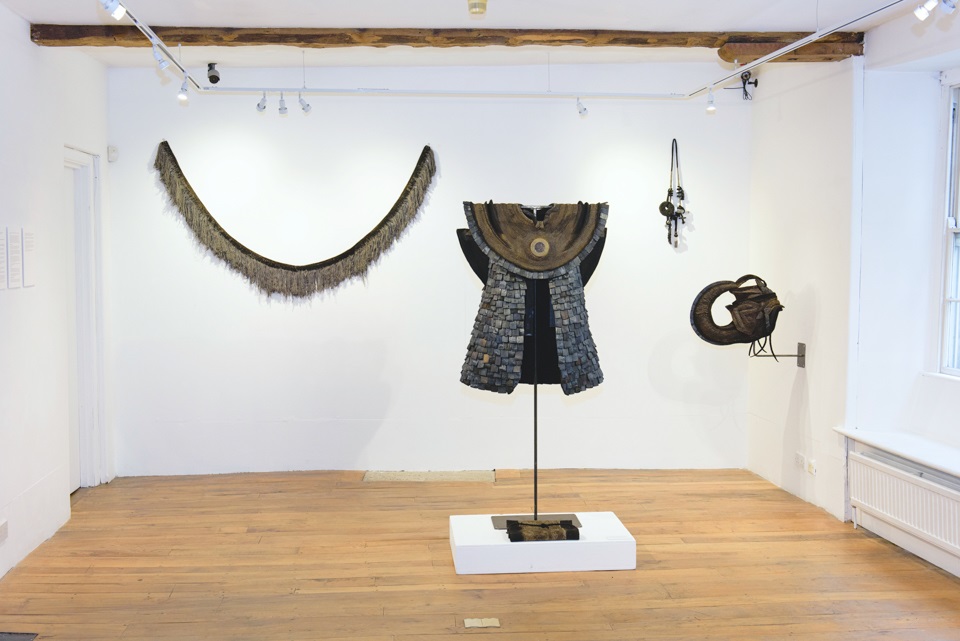
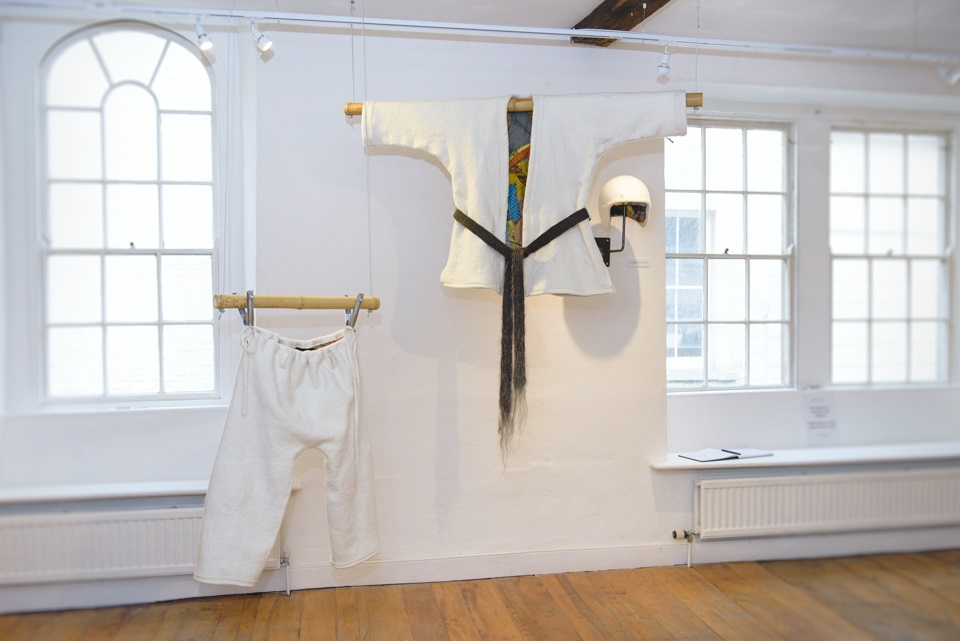
Rituals evolved organically from the process of creating Hinterland. These small objects started out as studies for each healing costume, but eventually became a ritual in their own right. After the intense journey of sitting with the story of an ancestor and the physically demanding aspect of making their costume, I would return to making small objects as a way to take a breath, cleanse myself of one story, and prepare myself for the next. They became a life line, a thread for me to hold on to, and find my way back to whenever I felt overwhelmed by the enormity of what I was trying to do. They became an intrinsic part of the 9 month ritual of mourning that Hinterland became, and they hold a quiet power in their own right. This life line offered me a way back to myself, in a sense, and for that reason I included them in the body of work.
But as much as they are part of Hinterland, it made sense for me to show Rituals on its own in Spinning a Yarn. For many of us who work with wool, whether it be as breeders, shepherds, shearers, weavers, spinners or dyers, there is an undeniable rhythm to each of these processes. These processes connect us to each other. I simply couldn’t do what I do without the people who tend the land and the animals, and that is a whole other level of alchemy at play, a sense of being part of something bigger.
And while my work and my medium may straddle the worlds of arts and crafts and cannot always so easily be placed, this perfectly reflects the way I myself straddle two worlds and cannot be so easily placed. Wool provides a connection between different elements of myself, and different elements of the world I inhabit, and for that, I love it.”
Gladys Paulus, December 2024
https://www.gladyspaulus.com/
Spinning a Yarn – Telling the story of Wool in Somerset
A Somerset Art Works project in partnership with South West Heritage Trust
Supported by Arts Council England and the Medlock Charitable Trust

 Spinning a Yarn - Take Part